Short answer: KOL stands for key opinion leader: a person whose views carry weight with a specific audience, so their recommendations can shape what that audience buys. In Malaysian marketing, a KOL is usually a creator on platforms such as Instagram, TikTok, Xiaohongshu (XHS) or YouTube, from a small niche creator to a well-known name. A brand pays or gifts the KOL to create content, and the KOL's followers see it as a recommendation rather than a conventional ad.
If you have been asked to "find some KOLs" for a campaign, this guide covers what the term means, where it comes from, how KOLs differ from influencers and KOCs, the main types by size, and how a KOL campaign works from brief to results.
What does KOL mean?
KOL means key opinion leader. The idea is older than social media. It comes from the "two-step flow" theory of communication developed by sociologist Paul Lazarsfeld in the 1940s: messages from mass media often reach a group through a few people who follow the topic closely, and those people then pass the message on, with their own opinion attached, to everyone else. Those people were called opinion leaders (The Paper).
Social media made that idea easy to see. Today a KOL is someone who has built an audience around a topic, such as beauty, food, parenting, fitness, gaming or property, and whose opinion that audience trusts. Marketers ask KOLs to share products or events because a recommendation from someone the audience already follows tends to feel more personal than a brand advertising itself.
KOL vs influencer: is there a difference?
In everyday Malaysian marketing talk, "KOL" and "influencer" are often used for the same people, and at KOL Nation we use both words for creators who work with brands. The term "KOL" has a slightly different emphasis, though. In its Chinese-market usage, an industry write-up by eMarketer explains that KOLs are creators who have developed expertise on a topic and built a relationship with their audience over time, while some other online personalities became famous for their internet presence without necessarily being trusted as experts on the products they promote (eMarketer). The same article notes that celebrities are not automatically KOLs: being well known does not mean your opinion carries weight on a specific subject.
The practical takeaway for a brand: do not choose a creator by fame alone. Ask whether this person's audience listens to them on your category. That is what vetting a KOL is for.
KOL vs KOC: what is a KOC?
You will also see KOC, short for key opinion consumer. Chinese market research firm iiMedia Research describes a KOC as an ordinary consumer, often an enthusiast in one area, who influences friends and followers to buy. Compared with a KOL, a KOC usually has fewer followers and less reach, but is more niche and costs less, and their content tends to feel like a normal user sharing a product rather than an expert endorsing it (21经济网 / iiMedia).
| KOL | KOC | |
|---|---|---|
| Stands for | Key opinion leader | Key opinion consumer |
| Who they are | A creator with an audience built around a topic | An enthusiastic everyday consumer who shares what they use |
| Reach | Usually wider | Usually smaller |
| Content feel | Creator or expert recommendation | Everyday user review |
| Typical use | Awareness, launches, events | Authentic reviews, seeding, social proof |
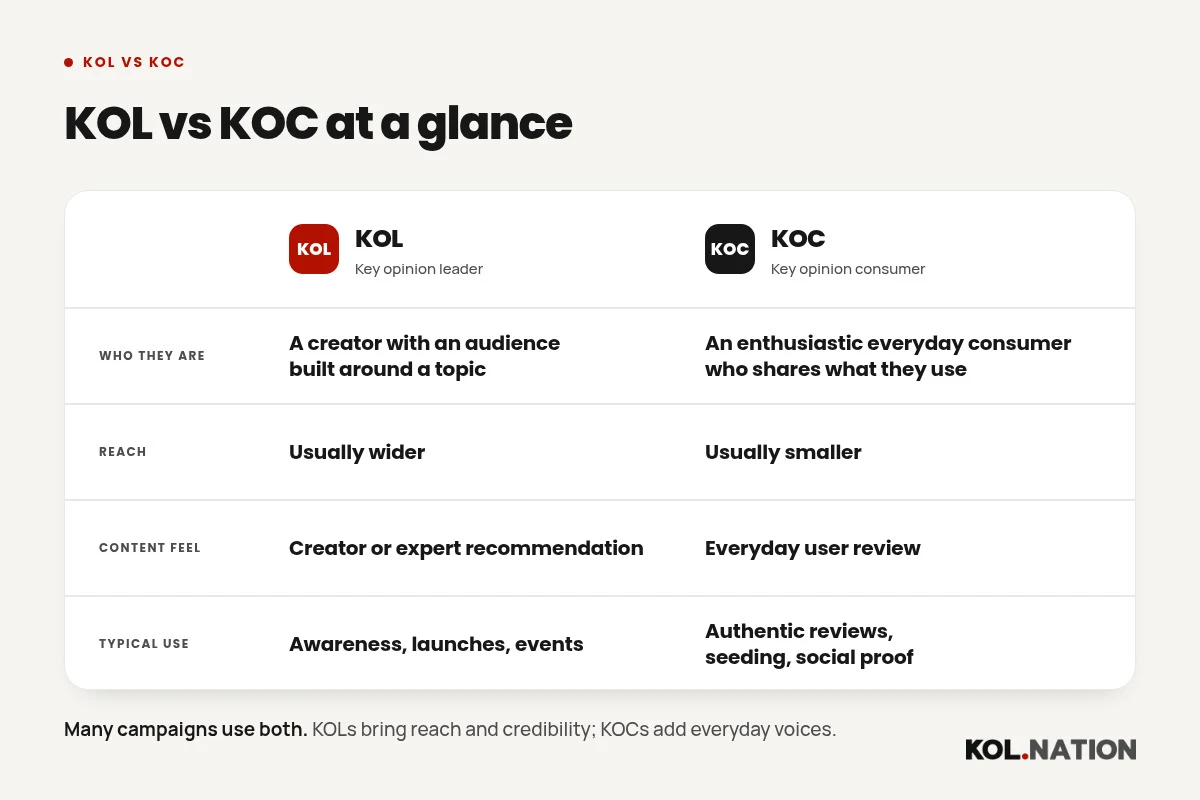
Many campaigns use both. KOLs bring reach and credibility, and KOCs add a layer of everyday voices.
The main types of KOL by follower count
The most common way to group KOLs is by audience size. There is no single official standard, and different sources draw the lines slightly differently. A widely cited breakdown, summarised on Wikipedia's influencer page, is:
| Type | Followers | Typical strength |
|---|---|---|
| Nano | Up to 10,000 | Close-knit, highly personal communities |
| Micro | 10,000 to 100,000 | Focused niche audiences |
| Macro | 100,000 to 500,000 | Broad reach with an established profile |
| Mega / celebrity | More than 500,000 | Mass awareness |
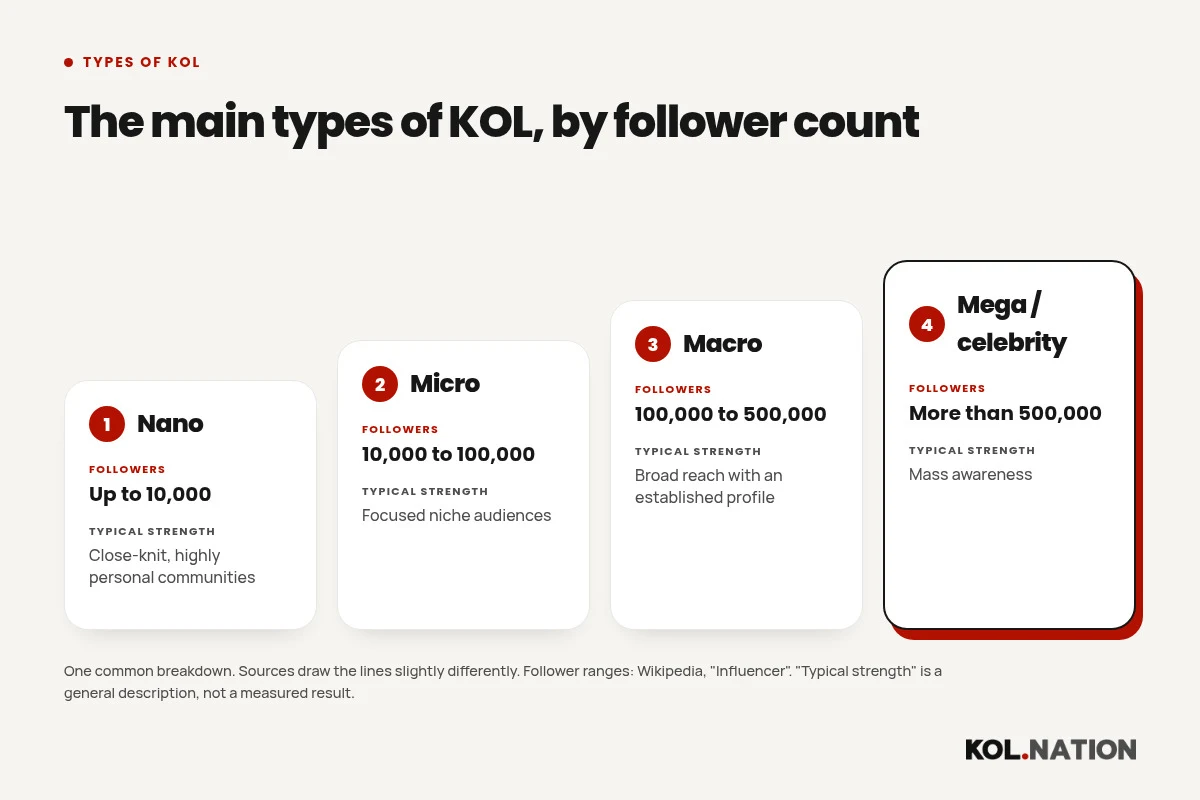
Source for the follower ranges: Wikipedia, "Influencer". The "typical strength" column is a general description, not a measured result.
Bigger is not automatically better. A smaller creator whose audience matches your customer can be a better fit than a famous one whose audience does not. For more on that trade-off, see our piece on niche influencers.
KOLs can also be grouped by:
- Platform: Instagram, TikTok, YouTube, Facebook or Xiaohongshu. Each platform has its own content style, so the same creator can behave differently on each.
- Niche: beauty, food, fashion, parenting, tech, gaming, property, health and lifestyle.
- Language and community: Malaysian audiences consume content in Bahasa Malaysia, English, Chinese or a mix, so the right creator for a Malay-language campaign may not be the right one for a Chinese-language campaign on XHS.
Why brands in Malaysia use KOLs
Social media is part of daily life in Malaysia. DataReportal's Digital 2026 report counted 30.7 million social media user identities in Malaysia in October 2025, equal to 85.0 percent of the population (DataReportal). Note that this counts user identities, so one person with several accounts can be counted more than once.
For a brand, that means most of its potential customers are already spending time on creators' content. A KOL campaign places your product inside that content, in the creator's own voice and for an audience that already follows them.
How a KOL campaign works
A typical campaign has six steps:
- Set a goal. Awareness, product seeding, an event, or sales. The goal decides the creator mix and the platforms.
- Shortlist and vet creators. Check audience location, age and language, engagement quality and past brand work. Our KOL vetting checklist walks through it.
- Write a brief. Give creators the goal, key messages, do's and don'ts, deadlines and approvals, and leave room for their own style. See how to brief a KOL.
- Agree the terms. Fee or gifted product, number of posts, usage rights, exclusivity and revision rounds. Our KOL rates guide explains what moves the price.
- Publish with proper disclosure. Paid or gifted collaborations must be labelled (see the next section).
- Track and review. Use unique promo codes, trackable links and the platforms' own analytics so you can tell what worked. See how to measure KOL campaign results.
Do KOLs have to disclose sponsored posts in Malaysia?
Yes. Malaysia's Content Code, revamped in 2022, introduced provisions on influencer marketing. According to a summary by law firm WJNT, advertising that involves an influencer under a commercial arrangement must be clearly disclosed as being in exchange for payment or some other reciprocal arrangement. The disclosure should sit in the content itself, with clear labels such as "Advertisement", "Ad" or "Sponsored". Vague terms such as "Sp", "Spon" and "Collab" should be avoided, disclosure in a video should be in the video itself rather than only in the description, and disclosure in live streams should be repeated periodically (WJNT).
Build this into every brief. Clear labelling protects both the brand and the creator. This is general information, not legal advice. Check the current Content Code if you need to be sure of the exact requirements for your campaign.
Common mistakes when starting with KOLs
- Choosing by follower count alone. Audience fit matters more than size.
- Skipping the brief. Creators cannot guess your goal, and a vague brief produces vague content.
- Over-scripting. Followers follow the creator for how they talk and film. Heavily scripted content reads like an ad.
- Forgetting tracking. If you set up codes and links before launch, you can see what worked afterwards. If you do not, you are guessing.
- Leaving out disclosure. Label paid and gifted posts clearly from the start.
- Starting too big. A small trial shows what works before you commit a larger budget.
How KOL Nation works with KOLs
KOL Nation, the KOL and influencer sister brand of Mojo Nation, runs KOL and creator campaigns across Instagram, TikTok, XHS and YouTube in Malaysia, for Chinese, Malay and English-speaking audiences. We start with a trial month rather than a long lock-in:
- Trial KOL Package: RM10,000 for the trial month, with 15 KOLs (10 nano and 5 micro) split across Instagram, TikTok and XHS.
- KOL Package: RM9,000 a month on a 6-month retainer after the trial, with an RM1,000 rebate on the trial cost if you sign up on a retainer.
- Content Creation Package: from RM8,000 a month, 6-month minimum.
- Combo Pack (content creation and KOL management): from RM15,000 a month.
T&C apply, and extra charges apply for special requests. Full details are in the packages section and our Terms of Use.
Want a campaign planned around your goal? Start with a trial month or get in touch. If you are a creator who wants to work with brands, you can register as a KOL.
Frequently asked questions
What does KOL stand for?
KOL stands for key opinion leader: a person whose opinion carries weight with a particular audience and can influence what that audience buys.
What is the difference between a KOL and an influencer?
In everyday Malaysian marketing the two words are often used interchangeably. The term KOL puts more emphasis on expertise and a trusted relationship with an audience on a specific topic, while "influencer" is the broader word for anyone with a social following. Fame alone does not make someone a KOL.
What is the difference between a KOL and a KOC?
A KOC is a key opinion consumer: an ordinary, enthusiastic customer who shares products they use. KOCs usually have smaller audiences and a more everyday feel than KOLs, and are typically more niche and lower cost.
What are the different types of KOL?
By follower count, a common breakdown is nano (up to 10,000), micro (10,000 to 100,000), macro (100,000 to 500,000) and mega or celebrity (over 500,000). Sources draw these lines slightly differently. KOLs can also be grouped by platform, niche and language.
How does KOL marketing work?
A brand sets a goal, vets and shortlists creators, briefs them, agrees terms, and the creators publish content with clear sponsored-content labels. The brand then tracks results with promo codes, trackable links and platform analytics.
Do KOLs have to disclose sponsored posts in Malaysia?
Under Malaysia's Content Code (revamped in 2022), advertising involving an influencer under a commercial arrangement must be clearly disclosed, using labels such as "Ad" or "Sponsored" inside the content itself. Check the current Code or take legal advice for your specific campaign.
How much does a KOL cost in Malaysia?
It depends on creator size, niche, platform, content type, usage rights and exclusivity. Our guide to KOL rates in Malaysia explains the drivers, and KOL Nation's own package prices are listed in the packages section.