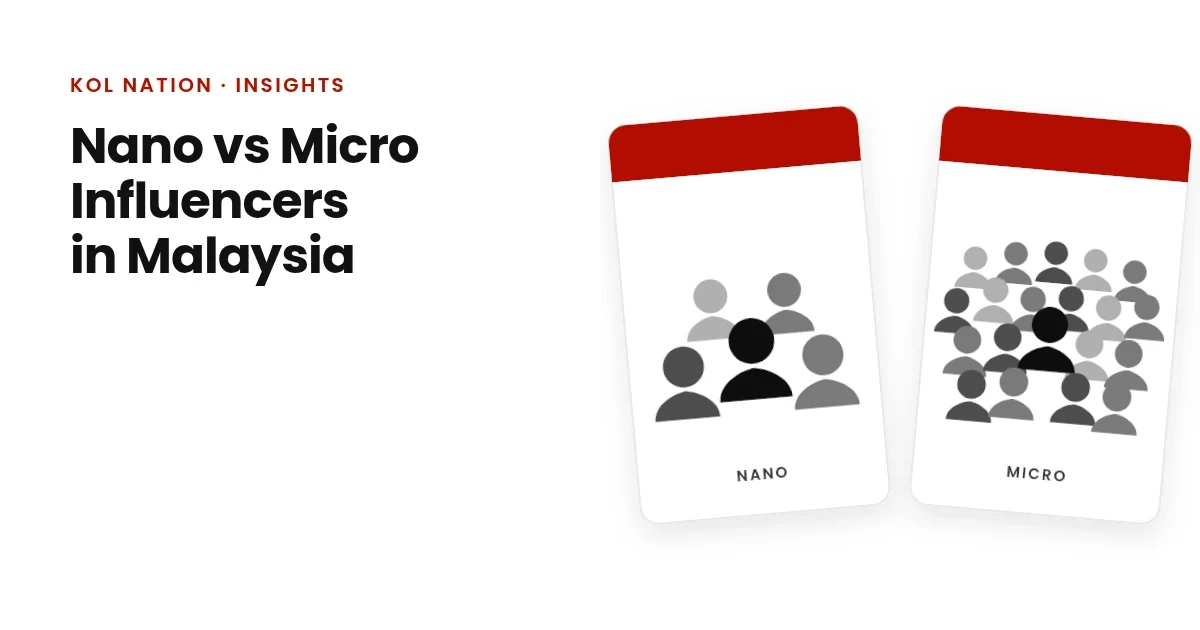
Should your next campaign use a crowd of small creators or a handful of bigger ones? For most brands, the honest answer is a bit of both.
Short answer: For micro influencer campaigns in Malaysia, mix the two tiers. Use nano influencers (commonly up to 10,000 followers) for volume, everyday-style reviews and product seeding. Use micro influencers (commonly 10,000 to 100,000) for niche authority, launches and content you can reuse. Pick a single tier only when your goal, budget or approvals point clearly to it. Follower bands vary by source, so treat these as common ranges, not rules.
If you're weighing up micro influencers in Malaysia for the first time, this guide shows how the tiers differ, when each one works, and how to build a mix.
What counts as a nano or micro influencer?
There's no official standard. Tiers are named by follower count, and every source draws the lines a little differently. Wikipedia's influencer page gives a widely cited breakdown: nano up to 10,000 followers, micro 10,000 to 100,000, macro 100,000 to 500,000, and mega or celebrity above 500,000 (Wikipedia).
Local sources split it differently. Modash's list of Malaysian micro creators defines micro as 1,000 to 25,000 followers (Modash). INSG, a Malaysian agency, puts nano at 1,000 to 5,000, micro at 5,000 to 20,000 and mid-tier at 20,000 to 100,000 (INSG).
Takeaway: Choose your own bands before you brief, and write them down. Then every quote compares like with like.
Nano influencers (KOCs)
Nano influencers are the smallest creators, often everyday people with a tight circle who happen to love a category. You'll often hear them called KOCs, short for key opinion consumers. iiMedia Research describes a KOC as an ordinary enthusiast who influences friends and followers, usually with fewer followers than a KOL, but more niche and lower cost. Their content tends to feel like a normal user sharing a product, not an expert endorsing it (iiMedia, via 21经济网). That source describes the China market, and Malaysian usage can differ.
Micro influencers (micro KOLs)
Micro influencers have a bigger, more focused audience. Marketing-Interactive describes them as creators with "as little as a few thousand followers" who typically have a niche focus, such as an illustrator sharing their process or a food reviewer who only covers matcha (Marketing-Interactive). In KOL terms, they're the micro end of the KOL spectrum with a clearer subject than most nano creators.
Takeaway: "KOC" describes a role and a content feel, while "nano" describes size. They overlap, but they aren't the same thing.
Nano vs micro influencers at a glance
| Nano | Micro | |
|---|---|---|
| Typical reach | Small, close-knit community | Larger, focused niche audience |
| Engagement style | Feels like a friend's recommendation | Feels like a trusted niche voice |
| Content polish | Everyday, less produced | Can be more produced |
| Cost driver | Usually lower cash fees, or gifted product | Usually higher fees, plus usage rights |
| Best for | Seeding, reviews, content volume | Launches, niche credibility, reusable content |
| Effort to manage | Many creators to brief and track | Fewer creators to brief and track |
These are general tendencies, not measured results. Individual creators vary a lot, so always check the person, not just the tier.
Takeaway: Use the table to shortlist a tier. Then vet individual creators, because tier is only a starting point.
When nano influencers work best
Nano creators shine when you want many authentic voices instead of one big one:
- Product seeding: send a product to many small creators and see who posts.
- Review-style content: KOC-style posts read like real customers.
- Community and local reach: a small creator can matter a lot inside one hobby group or community.
- Content volume: many creators means many angles to test.
Is the engagement really better? Wikipedia notes that research has found smaller creators had higher engagement rates and were seen as more relatable and credible (Wikipedia). That is a general finding, not a Malaysian benchmark, and engagement varies a lot by creator, platform and niche.
The catch is workload. Marketing-Interactive quotes Cult Creative's co-founder saying brands can find it hard to manage several smaller creators at once, because it eats into timelines and deadlines can slip.
Takeaway: Go nano for seeding and reviews, and give yourself time. Use one simple brief, one tracking method and a clear posting window for everyone.
When micro influencers work best
Micro creators are the better pick when you need a clearer message from a more established voice:
- Niche authority: a creator known for one subject lends your product credibility in that subject.
- Launches and events: a smaller number of creators means tighter messaging on a set date.
- Reusable content: Aspect Ratio Studios' founder told Marketing-Interactive that clients have used micro influencers' assets as ad creative, since the creators often lead on a strong idea.
- Strong storytelling: Lim also said a micro influencer might have a compelling story to tell, with high production value, even if reach falls short of what you expected.
If you plan to run their content as ads, agree usage rights up front, because reuse is normally charged on top of the creator's own post. Our KOL rates guide explains how.
One practical flag from the same article: most micro influencers aren't full-time creators, which can mean a slower turnaround. Build that into your timeline.
Takeaway: Go micro when you need a focused message and content you can reuse. Book early and agree usage rights in writing.
Why many Malaysian brands mix both
Mixing tiers means each does the job it's best at. Marketing-Interactive quotes Aspect Ratio Studios saying it would usually pick a celebrity or KOL as the face of a product and use micro influencers to sustain the noise. Havas Malaysia's CEO, Nizwani Shahar, said brands can work with multiple micro influencers to drive diverse yet targeted reach rather than rely on one high-profile figure.
Mixing also helps with language and platform spread. KOL Nation's campaigns run across Instagram, TikTok, XHS and YouTube for Chinese, Malay and English-speaking audiences, and one creator rarely covers every audience and platform. A mix of creators gives you more room to do that.
That's the thinking behind KOL Nation's trial model. If you're shortlisting a nano influencer agency, this is how ours works: 15 KOLs, made up of 10 nano and 5 micro, split across Instagram, TikTok and XHS. At the end of the month we review the results with you on a structured dashboard, so you can see which tier worked for your brand before you commit more. Details are in the packages section, and our case studies show the kind of campaigns we run.
Takeaway: Don't guess your ideal split. Run a small mixed trial, then put more budget behind the tier that delivers.
How to choose the right mix for your campaign
Run through these six questions before you shortlist anyone:
- Goal: is it awareness, seeding, reviews or a launch? Seeding and reviews often suit nano. Launches and niche credibility often suit micro.
- Budget: how much cash, and how much gifted product? Fix this first so you can price a set number of creators.
- Platform: where does your customer actually spend time? Instagram, TikTok and XHS each suit different formats.
- Language: will you need Malay, English, Chinese or a mix? Creators usually work in particular languages, so shortlist with that in mind.
- Approvals: do you need to approve scripts and drafts? Each extra approval round adds time, so build it into the schedule.
- Measurement: how will you tell what worked? Set promo codes and tracking links before launch.
Three guides cover the rest: how to vet a KOL, how to brief a KOL and how to measure KOL campaign results. For the case for niche over generic reach, see our piece on niche influencers.
Takeaway: Write your answers to the six questions into your brief, and your mix almost chooses itself.
What it costs
There's no single rate for nano or micro creators in Malaysia, and we won't pretend there is. Price depends on the creator's size and niche, the platform, the content type and amount, languages, revisions, usage rights, exclusivity, and whether you pay in cash or product. Marketing-Interactive quotes Aspect Ratio Studios saying a celebrity or KOL costs a lot more than a micro influencer. Our full guide to KOL rates in Malaysia breaks each driver down.
For reference, KOL Nation's live Trial KOL Package is 15 KOLs (10 nano and 5 micro) split across Instagram, TikTok and XHS, for RM10,000. T&C apply.
Takeaway: Fix your goal and creator count first, then ask for quotes that spell out deliverables and usage rights.
Ready to test the mix with your own brand? Talk to us about a Trial KOL Package.
Frequently asked questions
What is a micro influencer, and how is it different from a nano influencer?
A micro influencer is a creator with a focused niche audience, usually bigger than a nano influencer's. Nano influencers have the smallest audiences and often feel like everyday users. Common bands put nano at up to 10,000 followers and micro at 10,000 to 100,000, but sources vary.
Are micro influencers better than macro influencers for Malaysian brands?
Not better, just different. Micro influencers usually cost less than celebrities and speak to focused communities, while macro creators and celebrities offer wider reach. One Malaysian agency quoted by Marketing-Interactive uses a bigger name as the face of a product and micro influencers to sustain the campaign.
How much does a micro influencer cost in Malaysia?
It depends on the creator's size and niche, platform, content type, languages, revisions, usage rights and exclusivity, so there's no single rate. Our guide to KOL rates in Malaysia explains each driver and how to budget for a first campaign.
How many nano or micro influencers do I need for a campaign?
There's no fixed number. It depends on your goal, budget and how many platforms and languages you need to cover. More creators give more reach and more angles, but take more time to manage. KOL Nation's trial, for example, uses 15 creators: 10 nano and 5 micro.
Is a KOC the same as a nano influencer?
Not exactly, though they overlap. A KOC (key opinion consumer) is an ordinary enthusiast who shares products they use, and usually has a smaller audience. "Nano" simply describes follower count. Many nano influencers create KOC-style content, but the labels describe different things.
Which platforms work best for nano and micro KOLs in Malaysia?
It depends on where your customers spend time. We haven't found a reliable ranking, so don't pick by trend. Instagram, TikTok and Xiaohongshu (XHS) are common choices, and KOL Nation's trial splits creators across all three so you can compare how each performs.